How to Overcome Writer's Block: Spot Which Stall You're Actually In, Then Get Words Moving Again
Staring down a blinking cursor for an hour rarely means your talent ran out. Separate the four stalls that wear the same blank-screen mask—perfectionism, option overload, an empty well, or a hidden plot knot—and use low-friction habits that pry the first line loose.
Anyone who has ever tried to write seriously knows that eerie, prickly silence at the desk: water glass filled, phone turned face-down, chapter title typed neatly at the top of a clean page—and then dead air. The little black cursor blinks on, blinks off against the white screen. You stare at it for half an hour, get up to make tea, come back to stare for another half hour, type three stiff lines, select all, hit Delete, and watch a whole evening evaporate.
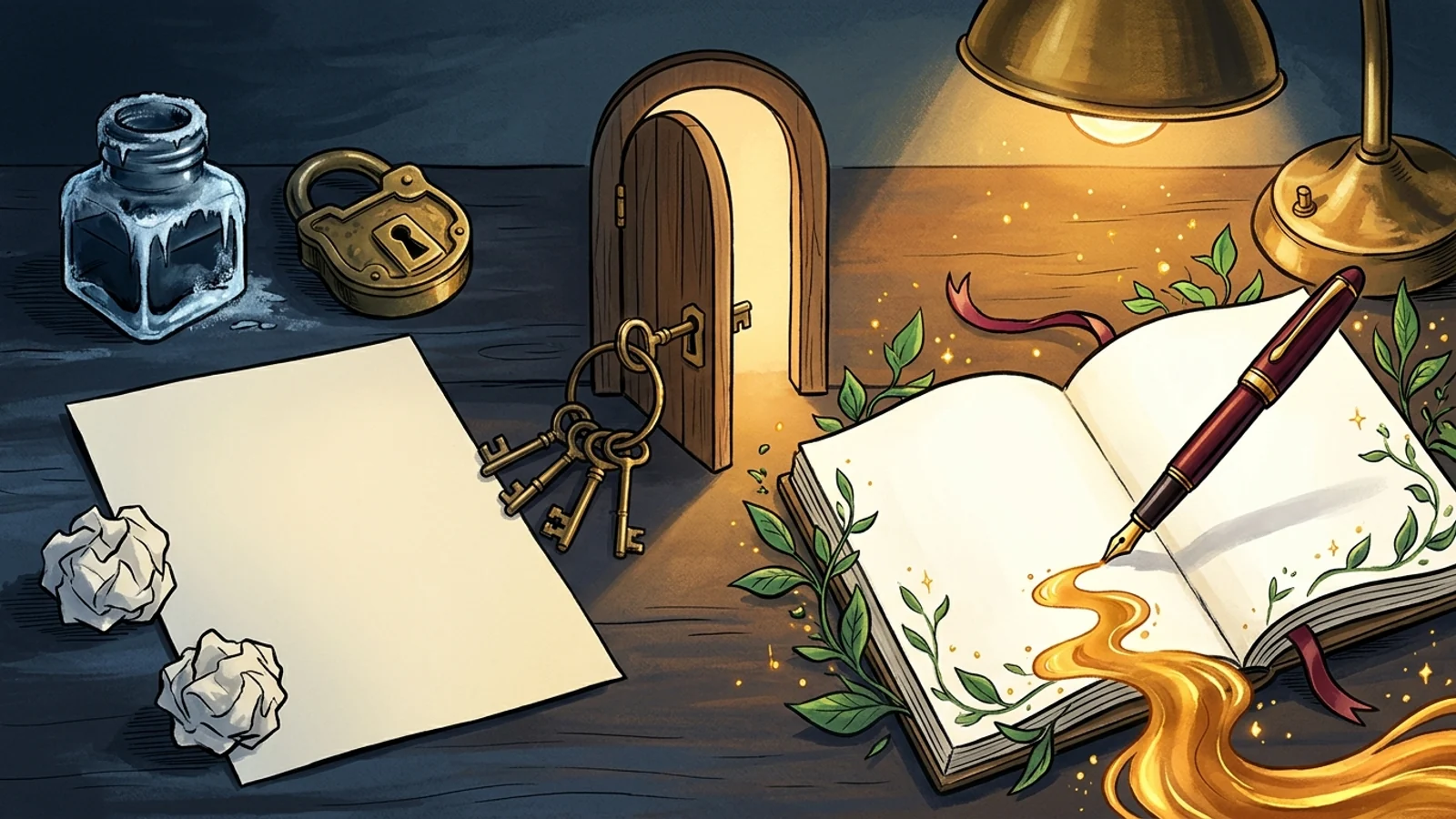
The cruelest trap when a night goes like that is turning on yourself—wondering whether your imagination dried up for good or whether you were kidding yourself about having a book in you. Put five working novelists or columnists around a table, though, and every single one of them has dozens of keyboard-smashing nights in their back pocket. Writer's block was never a mystical curse; it's just a door with a slightly finicky lock. Most of the time it refuses to budge for one simple reason: four completely different problems wear the exact same "can't write a word" face, and you're twisting the wrong key.
Before trying to muscle words onto the page tonight, spend two quiet minutes checking which stall actually showed up.
Check the pulse before forcing sentences: which stall hit you tonight?
Staring blankly at an empty document almost always traces back to one of four culprits underneath:
First—and by far the most common—your inner red pen clocked in before your hands warmed up. You barely get six words of an opening sentence onto the screen before a cranky voice in the back of your skull clears its throat: "That sounds flat. Didn't you use that verb in the last chapter?" Expecting raw first-pass sentences to arrive looking like typeset hardcover prose ties both wrists behind your back before you reach line two.
Second is crossroads paralysis. Your problem isn't having zero ideas; it's having five at once. Should this argument happen in a noisy bar or out on a wet street corner? Does the side character slip the secret tonight or hold it until the end of the part? Four or five viable routes wrestle in your head at the same time, you can't bear to close any of them off, and your fingers freeze mid-air.
Third is simply pumping a dry well. For three straight weeks you've been outlining, hitting daily word targets, and hauling buckets up out of your head without taking in a single page of an unrelated book or having an unhurried conversation outside—leaving your brain wrung out like a dry dishcloth where every word looks gray.
Fourth—and sneakiest of all—a hidden knot three chapters back. On the surface you think you're stuck on tonight's Chapter 15 opening; underneath, back in Chapter 12 you forced your protagonist into a plot turn that went against their grain just to hit an outline beat. Deep down your story instincts know the floorboards won't hold weight from here, so your hands go on strike rather than build on a crooked foundation.
Once you name which of those four is sitting across the desk, you can skip guessing and reach straight for the key that fits.
Scared of writing ugly lines: open a throwaway scratch sheet and drop the stakes
Whenever perfectionism has you frozen, the fastest jailbreak is getting out of your precious main manuscript file.
Your real chapter document intimidates you because every word typed inside it feels like it has to count. Minimize it, open a blank scratch file named Trash right beside it, set a 10-minute timer, and lay down one unbreakable rule: fingers keep moving until the timer rings, and Backspace is off-limits.
If your head feels completely empty, type "I'm annoyed and have zero clue how this scene starts or who speaks first when the door opens..." straight across the top two lines. Around minute four, something reliable happens: once "nobody will ever see this mess" is guaranteed, that nitpicking voice in your head gets bored and steps out of the room. Somewhere around sentence eight of your rambling warm-up, one unexpectedly sharp gesture or half-spoken barb almost always pops out—fish that single live line back into your real chapter, and the ice is broken for the night.
Ernest Hemingway's favorite old studio habit runs on the exact same psychology: never empty the tank dry at the end of a good writing session. Stop for the night while you still know the next two lines of dialogue that come next. Sit down tomorrow evening, and instead of facing a sheer white cliff, you're stepping onto a downhill ramp you already built for yourself yesterday; type those two waiting sentences, and momentum carries straight into the rest of the page.
Tripped up by paragraph one: jump straight past it to the scene your hands itch to write
Who ever passed a law saying a chapter has to be written from sentence one straight down in order?
Opening paragraphs do the most awkward heavy lifting in the whole chapter—catching the tail of whatever just happened, grounding the room, and setting the emotional temperature all inside three hundred words. Rather than burning two hours wrestling the doorway, type a blunt bracketed note right at the top of the page—[Leave blank—fill 200-word hallway entrance later]—and jump straight down to the heated exchange you can already hear in your head, or even write the exact closing line the chapter cuts out on first.
Once two thousand live words in the middle of the chapter are sitting safely in the bank, the tone and trajectory of the scene are already unmistakable—circling back to lay down two hundred words of doorway transition feels as easy as snapping a Lego brick into place.
Frozen at a crossroads: put on a small deliberate constraint, or talk it aloud first
Plenty of stalls happen simply because "anything could happen next" gives your brain nothing solid to push against. Flip that wide-open freedom on its head by clamping one narrow, artificial rule onto the scene: decide that the next five hundred words can use only spoken dialogue and what people do with their hands—zero internal monologue, or decide the entire confrontation has to finish before the kettle on the stove whistles. Instantly, "write a great scene" shrinks from an intimidating fog into a concrete puzzle with handles on it.
And on nights when your thoughts feel tangled like wet yarn and refuse to line up into neat written clauses, take your hands off the keyboard and say it out loud.
Typing invites us to put on our stiff "written prose" posture; speaking aloud drops us straight back into natural storytelling instinct. Hit record on a voice memo or trigger dictation inside your editor, and talk through the scene the way you'd tell a friend over coffee: "Okay, all that really happens here is the two of them run into each other on the stairwell, neither one wants to bring up last night's letter first, so he pretends to fumble for his keys..." Put that rough spoken transcript onto the page, smooth the joints twice by hand, and the spine of the scene is already standing.
Running on empty or stuck on a bad turn: take a real break, or back up one intersection
If you've tried all three of those moves and your fingers still feel filled with lead, stop ramming your shoulder against the door—stall three or stall four is almost certainly talking to you.
When your head is genuinely wrung dry, give yourself the evening off cleanly. Doomscrolling short videos for two hours while silently scolding yourself for not writing drains you worse than working; step completely away from screens instead—wander through a loud grocery market listening to how real people argue over produce, or read fifty pages of a biography or natural history book miles away from your own genre. You have to let groundwater seep back into the well before tomorrow's bucket brings anything up.
If you've rested up and still flinch every time you open this one specific chapter, check whether an earlier chapter took a crooked turn. Grab a scrap of paper and ask yourself honestly: back in Chapter 12 or 13, did I shove a character into an out-of-character choice just to manufacture a plot twist, leaving tonight's scene impossible to believe? Whenever the answer is yes, the fastest way forward is never grinding out five hundred false words—it's backing up to the intersection where the wheel slipped, pulling that pebble out of your shoe, and letting the road straighten out on its own.
Keeping kindling handy—and leaving gentle ladders inside Muses for stalled nights
Veteran writers learn early that the kindest cure for writer's block isn't hunting for matches after you've already frozen—it's keeping a dry box of tinder within arm's reach on ordinary days.
When we built Muses, we tucked gentle, low-friction ladders right into the exact spots where drafts usually stall, so a rough night never forces you out into three separate apps:
Whenever half a line of overheard dialogue, an odd world detail, or a character tic crosses your mind on a walk or right before sleep, toss it into the Inspiration library in the lower-left corner of your project—everything saved there stays easy to browse on blank nights, and the AI automatically draws on your project's Inspiration notes during chats and drafting so you're never staring into an empty void. When too many plot forks freeze you in place, flip the right-hand chat panel into Brainstorm mode and ask for contrasting scene routes to push against without letting it overwrite your prose (or test a couple of quick scene angles inside our continue story tool and AI story generator).
On evenings when your fingers flatly refuse to type, press Shift + Space right inside the editor to dictate aloud and get rough spoken storytelling onto the page first; and when you stall halfway through a stubborn sentence, tap Tab at the cursor to preview a faint inline continuation—accept it if the nudge gets your momentum rolling, or tap Esc to brush it away and keep moving in your own words.
Once words are flowing down the page again, the next craft problem is shaping and tightening what came out—when you're ready for that half of the ride, read on with how to get better at writing and the full workflow for writing a book with AI. Want to try a calmer desk tonight? Signing up is free and comes with the default Clio model plus 50,000 StarPower a month; if you upgrade later, paid plans are billed by subscription in US dollars, with current pricing shown on the checkout page. Start free.
Frequently asked questions
What is the fastest way to break writer's block when I can't get a single word out?
Close or minimize your real manuscript right away, open a throwaway scratch sheet you are allowed to delete afterward, and set a 10-minute timer for nonstop writing with hands off the Backspace key. Stepping outside the pressure that every sentence has to make the final cut quiets your inner editor—even if your first three lines are complaining that your mind is completely blank, once your fingers warm up, one usable gesture or half-line of dialogue usually surfaces on its own.
Why do I still freeze up at the keyboard even when I know where my story is headed?
Knowing the big arc doesn't stop three very common local stalls: either your inner copyeditor clocked in before your hands warmed up and started sneering at rough phrasing, or four competing ways to stage tonight's scene have you frozen at the crossroads, or weeks of nonstop output drained your reserves flat. Figuring out which of those three showed up tonight beats staring holes through the monitor every time.
When writer's block hits, should I force myself to push through or step away for a couple of days?
Match the move to the cause. If you are tripped up by an intimidating opening paragraph or afraid of writing clunky lines, staying at the desk and sneaking into the middle of the scene through a low-stakes side door works best; if you have been grinding hard for weeks until every sentence looks like lifeless static, sitting there feeling guilty only burns more fuel—shut the laptop, take a long walk, and read something completely unrelated to refill the well.
What should I do when every new chapter stalls out on the opening paragraph?
Skip the opening paragraph altogether and leave a bracketed note at the top for later. Nothing says a chapter has to be written from line one down—jump straight to the sharpest exchange of dialogue in your head, a concrete physical action, or even the final line the chapter snaps shut on, then come back for the doorway transition once the heart of the scene is standing.
What everyday habits keep writer's block from ambushing me so often?
Stop waiting until you sit in front of an empty document to go looking for kindling. Keep an easy-to-browse spark notebook on your phone or inside your writing workspace for overheard half-sentences, odd details, and atmospheric images, and end each day's session deliberately leaving half a sentence you already know how to finish for tomorrow—giving next night's self a downhill ramp instead of a cold wall.