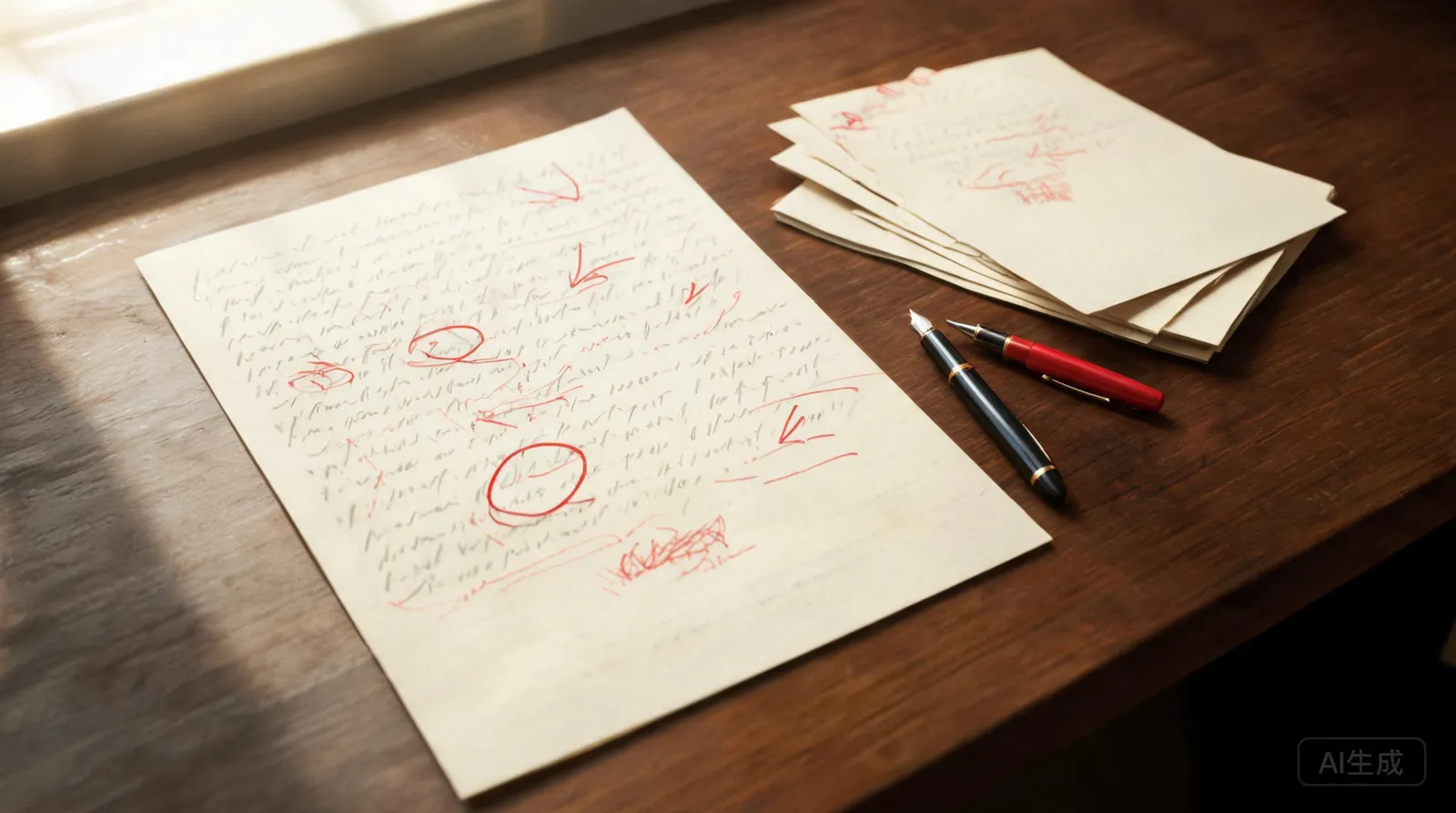
How to Get Better at Writing: A 4-Step Cycle With Exercises
Writing more won't make you better. Use a 4-step cycle—draft, distance, feedback, revise—with exercises and a worked before-and-after revision example.
You've been writing for months—maybe years. Journal entries, chapters, essays, drafts of every kind. And yet when you look back at your older work, you can't see much difference. The sentences are still a little loose. The structure still sags in the middle. The confidence still wavers.
Here's the uncomfortable truth: writing a lot and improving at writing are two different skills. Stephen King's famous advice—"If you want to be a writer, you must do two things above all others: read a lot and write a lot"—is where most writers stop. But the writers who actually improve have discovered a third requirement: they know how to write and improve in a deliberate loop, not just one after the other.
This guide breaks that loop into four steps and four exercises you can start using today.
Why Writing More Alone Doesn't Improve Your Writing Skills
Repetition without feedback doesn't build skill—it cements habit. If you write every day but never learn to see what's actually on the page (instead of what you meant to put there), you're practicing your mistakes until they feel intentional.
This is the difference between mere repetition and deliberate practice—it comes down to how you practice writing, not how much of it you do. A pianist who plays the same piece daily while ignoring the wrong notes doesn't gradually fix them. Improvement requires a signal that tells you where the gap is. For writers, that signal comes from three sources: distance from the draft, feedback from readers, and a structured way to revise.
The good news is that the best books on craft all converge on the same cycle, even though they describe it in different words. Anne Lamott gives you permission to write badly. Stephen King gives you the door you close and then open. Robert McKee gives you the layers to revise in. Blake Snyder gives you the tools that make problems visible. Together they form a complete method to get better at writing—cycle after cycle.
The 4-Step Cycle to Get Better at Writing
The framework has four steps:
- Draft — generate material without judging it.
- Distance — step away so you can see what you wrote.
- Feedback — find out what the words actually do to a reader.
- Revise — change the work in layers, from big structure down to individual words.
Then you repeat. King captured the whole cycle in a single sentence he learned from an editor early in his career: "write with the door closed, rewrite with the door open." The closed door is steps one and two—private, unjudged generation. The open door is steps three and four—the draft goes out, and the world gets a vote. Our close reading of On Writing traces how this one idea organizes everything else in the book.
Let's walk through each step.
Step 1: Write the Ugly First Draft
The first draft has one job, and it isn't quality. Its job is to exist.
Anne Lamott's chapter on "shitty first drafts" is the most quoted passage in writing instruction for a reason: "All good writers write them. This is how they end up with good second drafts and terrific third drafts." The ugly draft is not a failure of the process. It is the process—the stage where you discover what you actually think, not the stage where you perform it.
What kills first drafts is perfectionism. Lamott is blunt about it: "Perfectionism is the voice of the oppressor, the enemy of the people." When you edit every sentence before it reaches the page, you're not improving your writing—you're preventing it.
Two practical moves make drafting easier:
- Shrink the assignment. Lamott's famous one-inch picture frame reminds her "that all I have to do is to write down as much as I can see through a one-inch picture frame." You don't write "the chapter." You write the one conversation, the one scene, the one argument you can fully see right now. Our full reading of Bird by Bird covers this and the other habits that make large work possible.
- Separate the maker from the judge. You cannot generate and evaluate at the same time; attempting both at once is how pages stay empty. Give yourself explicit permission to be bad on the way to being good.
Try this: Set a timer for 25 minutes and write one scene, one argument, or one anecdote—whatever fits inside a one-inch frame—without touching the backspace key. You're producing a page that exists, not one you'd show anyone.
Step 2: Build Distance Before You Edit
Once the draft exists, your worst editor is the person who just finished writing it—you, still remembering every intention behind every paragraph. You read what you meant, not what you wrote.
King's solution is time. Finish the draft, then put it in a drawer for weeks if you can. When you return, you'll have partially forgotten the words, and the gap between intention and execution will finally become visible. You'll read it a little the way a stranger would.
Lamott offers a related image: "Writing a first draft is very much like watching a Polaroid develop." The picture isn't fully known when you press the shutter. Neither is your draft's real subject. Distance is what lets the image finish developing before you start cropping it.
If you can't wait weeks, borrow distance instead:
- Read it aloud. Your ear catches what your eye forgives—clunky rhythm, accidental rhyme, sentences that run out of breath.
- Change the format. Print it, change the font, or read it on a different device. Anything that makes the words look less familiar.
- Read backwards, paragraph by paragraph. This breaks the narrative pull so you evaluate each unit on its own merits.
Try this: Read the draft aloud and mark every place your voice stumbles—don't fix anything, just mark it. A stumble is where the sentence and the meaning disagree. Come back tomorrow and most of your marks will point at the same two or three habits.
Step 3: Get Feedback That Actually Helps
Distance shows you your own draft more clearly. Feedback shows you what the draft does to someone else—and those are different things.
King's version is the ideal reader: one person whose honest reaction he trusts completely. For him it's his wife, Tabitha. The point isn't that this person is always right; it's that their response is reliable enough to calibrate against.
Lamott's version is the trusted reader who combines care with candor—someone invested in you but honest about the page. The key, as our Bird by Bird reading puts it, is that this reader reports what the pages actually do: where attention sharpened, where belief weakened, where expectations were set up and then dropped. They don't rewrite it for you.
That last distinction matters, because most writing feedback fails by being either too vague or too prescriptive. "It's good!" tells you nothing. "Cut the second paragraph" hands you a decision that should be yours. The useful middle ground is specific observation:
- "I got confused here about where they were."
- "I expected the argument to pay off after this example, and it didn't."
- "My attention drifted starting at this paragraph."
McKee's craft vocabulary makes this even more precise. Because a story is built of scenes that turn values from one state to another, you can ask a reader scene-level diagnostic questions: What did you think was at stake here? Where did the situation change? What did you expect next? Our deep dive into Story covers this scene-analysis toolkit in detail.
An AI writing assistant can take part of this role, especially early, when you want a fast and unembarrassed reaction before spending a human reader's goodwill. What matters is which step you hand over. Ask a model to write the draft and you skip the part where the thinking happens; ask it the scene-level questions above and you've only shortened the slowest step in the loop. Models do differ here, a separate question we take up in which Claude model actually writes best.
Try this: Instead of asking what a reader thought, send three questions: Where did you get confused? Where did your attention drift? What did you expect after the opening? Vague praise is the honest answer to a vague request.
Step 4: Revise in Layers, Not All at Once
Here is where most self-editing collapses: writers open the draft and start polishing the first sentence. Hours later, the opening sparkles and the middle still doesn't work—and now they're attached to sentences that may not survive the fix.
Revise in order, from big to small:
- Structure. Where does the piece truly start? What setup never pays off? What arrives without preparation? King insists revision begins above the sentence—you ask where the story really begins before you spend an hour polishing a paragraph that precedes it.
- Scenes and sections. Does each unit turn? Does each one earn its place? McKee's hierarchy makes this concrete: "Make your beats build scenes, scenes build sequences, sequences build acts, acts build story to its climax." Revision moves through the same ladder.
- Paragraphs and sentences. Now the line editing happens—rhythm, clarity, word choice.
- Compression. King famously passes along the formula from an old rejection note: "2nd Draft = 1st Draft - 10%." Treat it as pressure toward tightness, not a mechanical rule—and check the word count before and after, because the size of a cut is far easier to feel than to estimate. Most drafts are padded, and cutting is the fastest improvement available to any writer.
Two tools from Blake Snyder make structural problems visible instead of vaguely felt:
- The logline. State the piece in one sentence—who wants what, against what, with what at stake. Snyder calls the logline "your story's code, its DNA, the one constant that has to be true." When a revision starts drifting, return to that sentence and check which version you're actually serving.
- The board. Write each scene on a card and lay them out where you can see the whole shape at once. Gaps and overloads that were invisible in the manuscript become obvious as empty stretches and crowded stacks. Snyder's method was built for screenplays, but it works on essays and chapters too—our Save the Cat! reading covers how to adapt it.
A Worked Example: 79 Words Down to 30
Layer order is easier to trust once you watch it happen. Here is a paragraph of the kind a first session produces:
In today's fast-paced world, it is very important to note that most companies are currently in the process of trying to figure out what their approach to remote work should be going forward. There are a number of different factors that need to be taken into consideration here, and many managers, in my personal opinion, have not really thought very carefully about the fact that trust, and not physical proximity, is actually the thing that makes distributed teams work.
Structure pass. The point is in the final clause. Everything before it is a writer clearing their throat, so the claim moves to the front and the survey framing—fast-paced world, a number of different factors—goes with it. That was scaffolding, not content.
Trust, not physical proximity, is what makes a distributed team work. Most managers still haven't accepted that, which is why their remote-work policies keep circling the question of where people sit instead of the question of whether anyone is trusted to make a decision alone.
Sentence pass. Now, and only now, the lines. The question of appears twice and both go. Which is why becomes a full stop, because a causal link lands harder outside a relative clause. The hedges—in my personal opinion, actually—already went with the structure.
Trust, not proximity, makes a distributed team work. Most managers haven't accepted that. So their remote-work policies keep arguing about where people sit rather than whether anyone is trusted to decide anything alone.
The last ten percent. Thirty-three words, three of them doing nothing. Keep arguing becomes argue. Whether anyone is trusted becomes who is trusted. Anything goes, because decide alone already carries it.
Trust, not proximity, makes a distributed team work. Most managers haven't accepted it, so their remote-work policies argue about where people sit rather than who is trusted to decide alone.
Seventy-nine words to thirty. Notice where the cutting happened: the structure pass took thirty-four words in one move, and King's celebrated ten percent came off last, once nothing was left to fix above the sentence. Reverse that order and you spend an hour perfecting the throat-clearing.
Try this: Take something you finished last month and run it through the four layers in order, one pass each, without jumping ahead to the sentences. This is the smallest version that works: one old piece, four passes, one sitting.
Make Improvement Measurable
The cycle only compounds if you can see your own progress. Otherwise every revision feels like starting over, and the motivation drains away.
Three habits keep the gains visible:
- Keep your old drafts. When you finish a piece, don't delete the ugly versions. Rereading last quarter's first draft next to this quarter's is the most convincing proof that the cycle works.
- Keep a personal error list. Every editor you'll ever have notices that you have three or four signature mistakes. Write yours down—overusing adverbs, burying the point, opening with throat-clearing—and check for them explicitly during the sentence-level pass.
- Design the next draft before you write it. McKee's method for screenwriters—working through step-outline before prose, putting off polished dialogue as long as possible—isn't just for screenplays. It's the general insight that improvement can be planned before drafting, not only rescued afterward.
Mistakes That Keep Your Writing From Getting Better
Only writing, never revising. You produce endless material but never close the loop. Volume without the cycle is how a decade of journaling adds up to very little growth.
Only revising, never finishing. The perfectionist mirror image: endless polishing of the same three pages. Lamott's test for knowing when you're done is a judgment made after repeated revision and feedback—not the arrival of a version that could never be changed again. At some point, the draft has done its job, and the next piece will teach you more.
Fixing every layer at once. Polishing sentences inside a section you're about to restructure is decoration on a condemned building. Layer order exists because structure decisions invalidate sentence decisions, never the reverse.
Treating feedback as a verdict. Feedback is information about the draft's effect, not a ruling on your worth or talent. You listen, you decide, and the responsibility for the solution stays with you—that's the position of strength in the whole cycle.
The Bottom Line
Writing and improving are two skills, and the writers who grow fastest are the ones who refuse to separate them. Close the door and write the ugly draft. Walk away long enough to forget your intentions. Open the door to one reader whose honesty you trust. Then revise in layers, from structure down to words, and cut ten percent on the way out.
Repeat that loop enough times and the evidence becomes impossible to ignore—old drafts you can't believe you wrote, new ones you're proud of, and a sense that the craft is finally, visibly moving. That is what it takes to write well: not more words, but more turns of the loop.
If you want to go deeper on any step of the cycle, our close readings of On Writing, Bird by Bird, Story, and Save the Cat! break down each book's method in full. And if a stalled draft rather than a slow cycle is your problem right now, start with How to Overcome Writer's Block.
Ready to shorten your feedback loop? Muses is a writing environment designed for exactly that—draft, get AI feedback, and revise in one place, so the whole improvement cycle happens inside your writing tool instead of scattered across it. Try it free
Frequently asked questions
How can I improve my writing skills fast?
You can't rush the cycle, but you can shorten it. One loop of draft, distance, feedback, and layered revision teaches more than a month of unexamined writing. If speed matters, shrink the piece: a 300-word draft that goes around the loop weekly beats a 3,000-word draft nobody ever reads.
How long does it take to get better at writing?
Nobody has a credible number for this, and anyone who gives you one is guessing. What changes first is self-correction: writers who run the cycle start catching their own habits before a reader points them out. The larger gains compound over years, arriving as fewer bad drafts rather than sudden good ones.
Is reading enough to become a better writer?
Necessary, not sufficient. Stephen King treats reading as the creative center of a writer's life, and it's where rhythm, structure, and possibility enter your system. But reading supplies the patterns; only the cycle teaches you to apply them. Read without revising and you end up with good taste and no method.
How much should I write every day to get better?
Less than the internet tells you, and more regularly. A daily word target measures output, not skill; hitting it every day while never revising won't move you. Pick a number you can hit on a bad day, then spend the time you save on distance, feedback, and revision.
Can you get better at writing without a class or a teacher?
Yes, with one condition: you'd have to solve the feedback step some other way. Everything else in the cycle works alone. What a class sells is a reliable reader and a deadline, and both can be sourced elsewhere: one honest friend, a writing group, an editor paid by the hour. Skip feedback and you're rehearsing your habits.
Does using AI to write make you a worse writer?
It depends on which step you hand over. If AI writes the draft, you skip the part where the thinking happens and learn nothing, because the struggle was the lesson. Using it as a first reader is different: you still draft, decide, and revise, and only get a reaction sooner. One replaces the work; the other shortens the loop.